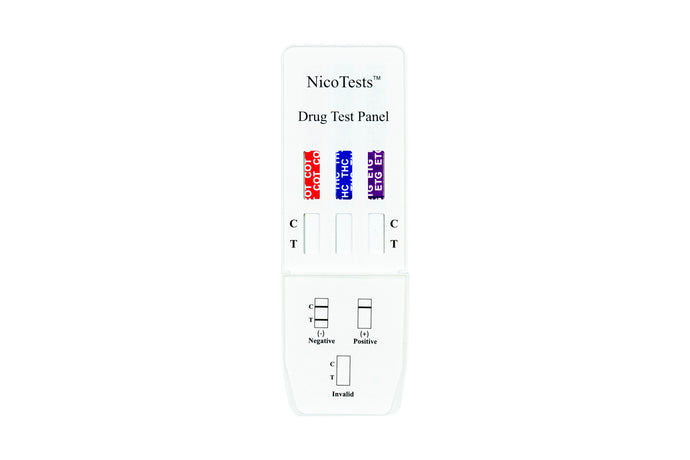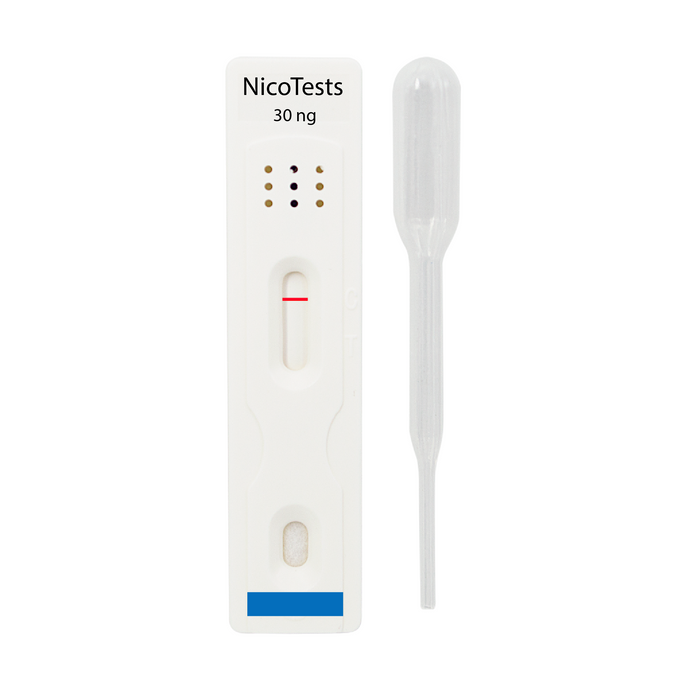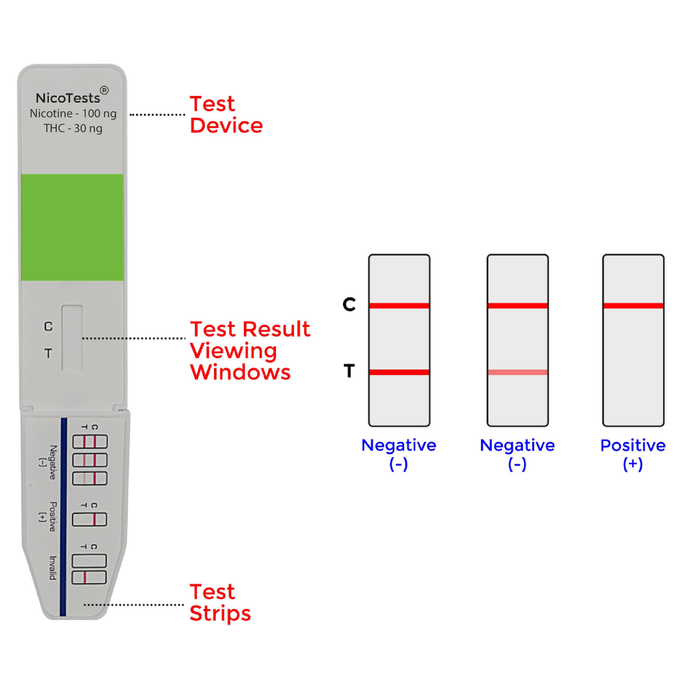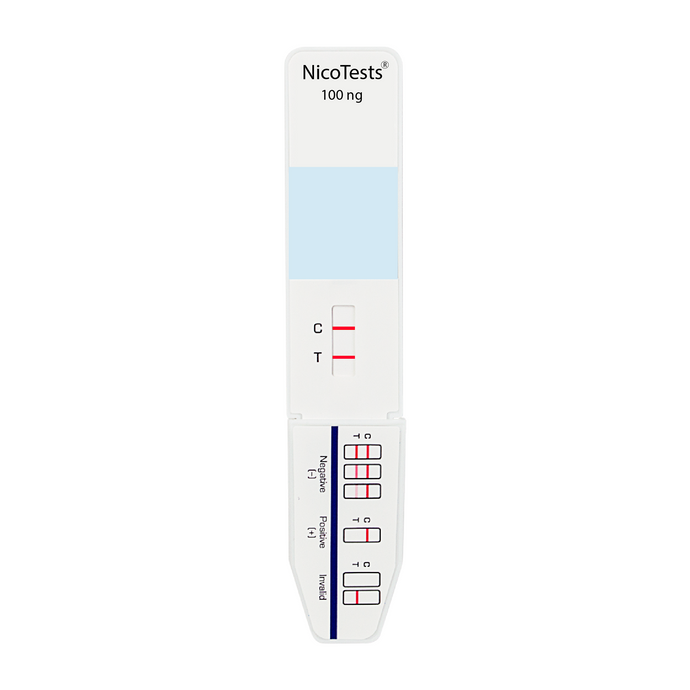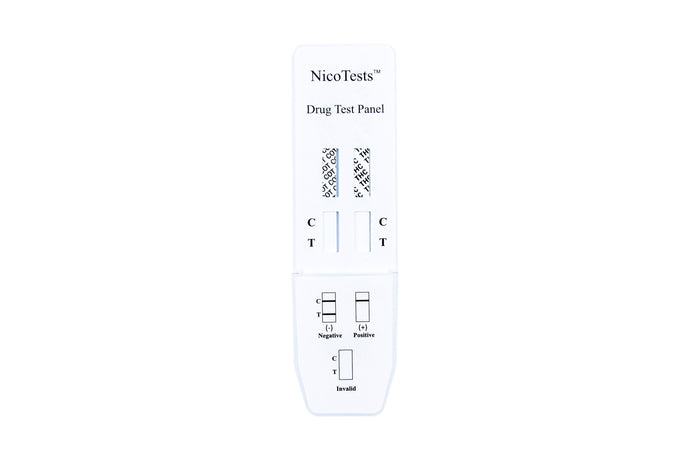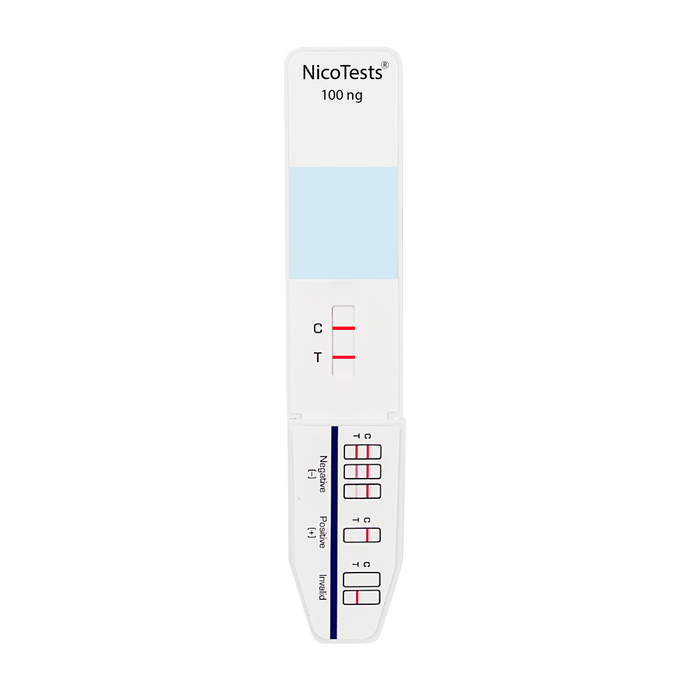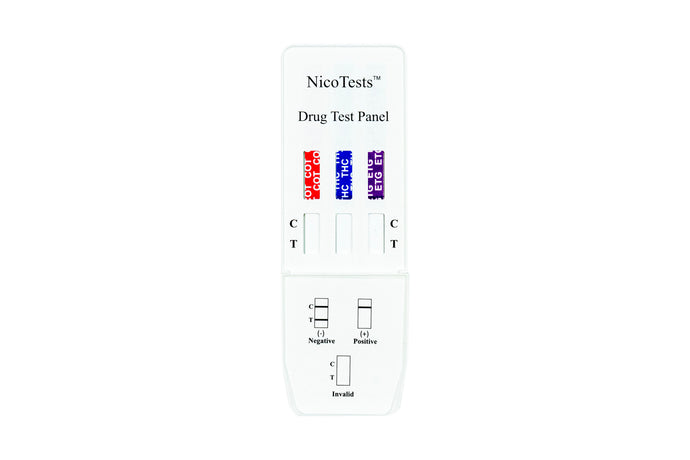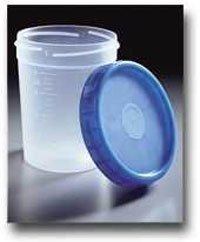
A very popular 5-drug EZ split cup. The EZ Split cup provides immediate
results. The test sample is split into two chambers, making for easy
confirmation of the untouched sample, should this be necessary.
The CLIA-certification means this test meets federal government standards for
both ease of use and clarity of result interpretation.
Download Additional Information Related to This Product:
INTENDED USE
This drug test cup is an immunochromatographic assay for
rapid qualitative detection of drugs of abuse and their principal metabolites in
urine at specified cutoff concentrations listed below:
| ABBREVIATION |
TARGET ANALYTE |
CUT-OFF (ng/mL) |
| COC |
Cocaine |
300 |
| THC |
Marijuana |
50 |
| mAMP |
Methamphetamine |
1,000 |
| OPI |
Opiates |
2,000 |
| PCP |
Phencyclidine |
25 |
This assay is intended
for professional use. It is not for over the counter sale.
Note: This assay provides only preliminary analytical test results. A more
specific alternative chemical method must be used in order to obtain confirmed
analytical results. Gas chromatography/mass spectrometry (GC/MS) is the
preferred confirmatory method. Clinical consideration and professional judgment
should be applied to any drug of abuse test results, particularly when
preliminary results indicated positive.
SUMMARY AND EXPLANATION OF THE TEST
Drug abuse remains a growing social
and economic concern in many developed and developing countries throughout the
world. The above stated drugs are among the most frequently abused illicit drugs
according to the U.S. Substance Abuse and Mental Health Services Administration
(SAMHSA) and the U.S. Department of Health and Human Services.
This drug test cup uses a fast, qualitative, visually read competitive
immunoassay method for screening without the need for instrumentation. The
method employs a mixture of antibodies and antigens to selectively identify the
drugs of abuse and their metabolites in test samples with a high degree of
sensitivity.
The length of time following drug use for which a positive result may occur
is dependent upon several factors including the frequency and amount of drug,
metabolic rate, drug half-life, and the drug use’s age, weight, activity, and
diet.
PRINCIPLE OF THE TEST
The drug test cup is a competitive immunoassay in
which drugs and drug metabolites in a urine sample compete with immobilized drug
conjugate for limited labeled antibody binding sites. By utilizing antibodies
that are specific to different drug classes, the test permits independent,
simultaneous detection of up to twelve drugs from a single urine sample. The
test results can be read at 5 minutes.
In the assay procedure, urine mixes with labeled antibody-dye conjugate and
migrates along a porous membrane. When the concentration of a given drug is
below the detection limit of the test, unbound antibody-dye conjugate binds to
antigen conjugate immobilized on the membrane, producing a colored line in the
appropriate Test Zone for that drug. Conversely, when the drug level is at or
above the detection limit, free drug competes with the immobilized antigen
conjugate on the membrane by binding to antibody-dye conjugate, forming an
antigen-antibody complex and preventing the development of a colored line in the
Test Zone.
Regardless of the drug levels in the sample, a colored line is produced in
each Control Zone by a parallel immunochemical reaction. The presence of this
colored line in the control region serves as 1) verification that sufficient
volume is added and 2) that proper flow is obtained.
MATERIALS PROVIDED
1. Test cups with strips containing dye-conjugated
antibody and immobilized antigen in a protein matrix with sodium
azide.
2. Test Instructions.
MATERIALS NEEDED BUT NOT PROVIDED
1. Timing device (i.e., timer,
clock, watch, etc.)
WARNINGS AND PRECAUTIONS
1. For in vitro diagnostic use.
2. For
professional use only.
3. Do not use the test device beyond the expiration
date.
4. Use a new device for each urine test to avoid cross contamination of
urine samples. The drug test cup cannot be reused.
5. Urine specimens may be
infectious; properly handle and dispose of all urine and urine reaction devices
in a biohazard container.
6. Visually inspect the foil package to ensure it
has not been compromised before beginning the test. If the package does not
reach you intact, the integrity of the test cup may be comprised.
STORAGE AND STABILITY
Store test kit below 28ºC (83ºF); do not freeze. If
stored at 2º-8ºC (36ºF-46ºF), allow the test kit to reach room temperature
15º-28º (59º-83ºF) before performing the test. The test cup will be stable until
the expiration date as printed on the foil package.
SPECIMEN COLLECTION AND PREPARATION
Fresh urine specimens should be
collected directly into the cup with a minimum of 30ml volume and do not require
any special handling or pre-treatment. The drug test cup employs a thermal strip
to validate the urine collection. This device should be checked immediately
after collection.
Note: Urine specimens can be transferred from a urine collection container
into the drug test cup if necessary.
TEST PROCEDURE
Do not break the seal of the protective pouch until ready
to begin testing.
1. Tear open the foil pouch and remove the test cup.
2. Issue the device
to the individual to be tested.
3. Have them urinate directly into the Drug
test cup. Ensure the specimen is above the minimum level line on the test
label.
4. The cup must be returned immediately to the collector. Authorized
personnel at collection sites to remove tear-off label and read the results at
five minutes post collection.
NOTE: In order to prevent any incorrect results, the test results should not
be interpreted after 8 minutes.
Each of the tests is read individually and independently of one another.
Positive: A colored line is visible in each Control Zone. No
color line appears in the Test Zone, indicating a preliminary positive result
for the corresponding drug of that specific Test Zone. Send this urine specimen
to a certified laboratory for confirmation.
Negative: A colored line is visible in each Control Zone and
in the Test Zone, indicating that the concentration of the corresponding drug of
that specific test zone is below the detection limit of the test.
Invalid: If a colored line is not visible in the Control
Zone, the test is invalid. Another test should be run to re-evaluate the
specimen. Each strip in the drug test cup is read and functions independently.
An invalid result on one test strip does not invalidate other results derived
from the same device.
Note: There is no meaning attributed to the line color intensity or width.
Any evidence of a line should be considered a line.
1. Adulteration Strip Results are obtained by direct comparison of the
reacted strips with the color blocks. Adulterated urine will show result colors
under the “Abnormal” block colors of the color chart. Unadulterated samples will
show strip colors similar to the “Normal” block colors of the colors chart.
pH: Normal urine pH ranges from 4.5 to 8.0 Values below pH
4.0 or above pH 9.0 are indicative of adulteration.
Specific Gravity: Random urine may vary in specific gravity
from 1.003 – 1.030. Normal adults with normal diets and normal fluid intake will
have an average urine specific gravity of 1.016 – 1.022. Elevated urine specific
gravity values may be obtained in the presence of moderate quantities of
protein. A urine specimen with a specific gravity level of less than 1.003 can
be an indication of substitution. Specific gravity and creatinine values should
be considered together to provide a better picture of whether the sample is
substituted.
Creatinine: Daily creatinine excretion, related to muscle
mass of the human body, is usually constant. A urine specimen with creatinine
levels of less than 5 mg/dl is an indication of substitution.
Available in quantities that are multiples of 25.